2026 University of Toronto Teaching & Learning Symposium

Blog

Teaching Orally

A part of 4.1 Lightning Talk session Daveeda Goldberg, Sessional (CUPE 3902, Unit 3)/CLTA, ELL, FAS Back in the 1970s, Marshall McLuhan argued that TV, film and radio represented a new "electronic culture," and that this constituted a return to "the Oral," that is, a return to synchroneity, to village mentality, and, following from those, a return to egalitarian, intimate, and immediate communication. However, from a more contemporary p.o.v, it might seem that McLuhan was just wrong, and that, instead of turning up the volume on the Oral, digital communication has re-enlivened a Print-like, asynchronous culture of communication [...]
Teaching Orally2022-05-02T14:30:42-04:00

Tutorials on Demand

A part of 2.3 Lightning Talk session Catherine Barrette, Assistant Professor, Teaching Stream, Rotman School of Management Katherine Hovdestad, B.Com 2022, Co-Head TA for RSM 222 course Every year, we would observe the attendance to in-person tutorial dropping significantly as the term goes on. By the time of the mid-term, attendance would be 10% or lower. However, during the pandemic and moving the tutorial online, we noted an increase in attendance. This prompted us to review the tutorial format and move our tutorial content to an asynchronous mode (Khan Academy style). We worked to develop over 20 asynchronous [...]

Tutorials on Demand2022-05-02T14:10:03-04:00

Centering Indigenous guest speakers to teach a critical history of anthropologist-Indigenous relations

A part of 2.2 Lightning Talk session Krista Maxwell, Assistant Professor, Anthropology, FAS Katherine Patton, Assistant Professor Teaching Stream, Anthropology, FAS As anthropologists, we are increasingly aware of the importance of challenging our discipline’s historical and ongoing complicity in settler colonialism in our teaching as well as our research. Here, we propose a teaching model that centers often marginalized expertise and experience as a tool for learning disciplinary historical consciousness and reflexivity that may be of interest to other disciplines. At the heart of our newly-developed online course Anthropologists & Indigenous Peoples in North America are five guest [...]

Centering Indigenous guest speakers to teach a critical history of anthropologist-Indigenous relations2022-05-02T14:03:10-04:00

Cultivating a Questioning Mind: Student led Question Composition in Large Courses

A part of 2.2 Lightning Talk session Naomi Levy-strumpf, Assistant Professor, Teaching Stream, Human Biology Program, FAS Maria Papaconstantinou, Associate Professor, Teaching Stream, Human Biology Program, FAS Asking a good question is not a trivial task. It requires deep comprehension and concept integration. To facilitate critical thinking and mastering of foundational concepts in a large Genetics course (~1000 students), we decided to actively engage students in question creation. We used “Quizzical”, an online platform developed by Prof. Dan Riggs. Via this platform, students are tasked with the creation of multiple-choice questions. For each of the suggested answer choices, [...]

Cultivating a Questioning Mind: Student led Question Composition in Large Courses2022-05-02T13:44:53-04:00

I’m so confused – and that’s a good thing – how to (properly) use misconceptions and intentional mistakes in your teaching strategies and assessments moving post-pandemic

A part of 2.2 Lightning Talk session William Ju, Associate Professor, Teaching Stream, Human Biology Program, FAS Ron Wilson Jr. Associate Professor, Teaching Stream, Human Biology Program, FAS During the shift to online teaching use of the use of student chats during synchronous delivery and Discussion Boards for asynchronous engagement have increased greatly. These platforms, among many, are powerful ways for students to engage in peer to peer teaching and learning. One of the teaching methods that we have previously employed in courses (both online and in-person), has been to incorporate intentional mistakes as well as introducing misconceptions [...]

I’m so confused – and that’s a good thing – how to (properly) use misconceptions and intentional mistakes in your teaching strategies and assessments moving post-pandemic2022-05-02T13:38:34-04:00

Positionality Through Reflection on Connections With Land

A part of 5.2: Lightning Talk session. Positionality Through Reflection on Connections With Land Kerry Taylor, Assistant Professor, Teaching Stream, Criminology & Socio-Legal Studies, FAS Sabeen Kazmi, PhD Candidate (CRI364 Teaching Assistant), Centre for Criminology & Socio-Legal Studies, FAS The session will focus on description, discussion and reflection upon an assignment called, “Connecting and Learning With Land” for CRI364, “Indigenous Peoples & Criminal Justice” (undergraduate 300-level course) at the Centre for Criminology & Socio-Legal Studies. Course facilitator, Professor Kerry Taylor, and teaching assistant, Sabeen Kazmi will share and discuss this assignment in terms of pedagogy, learning objectives, evaluation, [...]

Positionality Through Reflection on Connections With Land2022-05-12T15:19:47-04:00

Assignments Across Disciplines: Creating a Community of Practice around Assessment

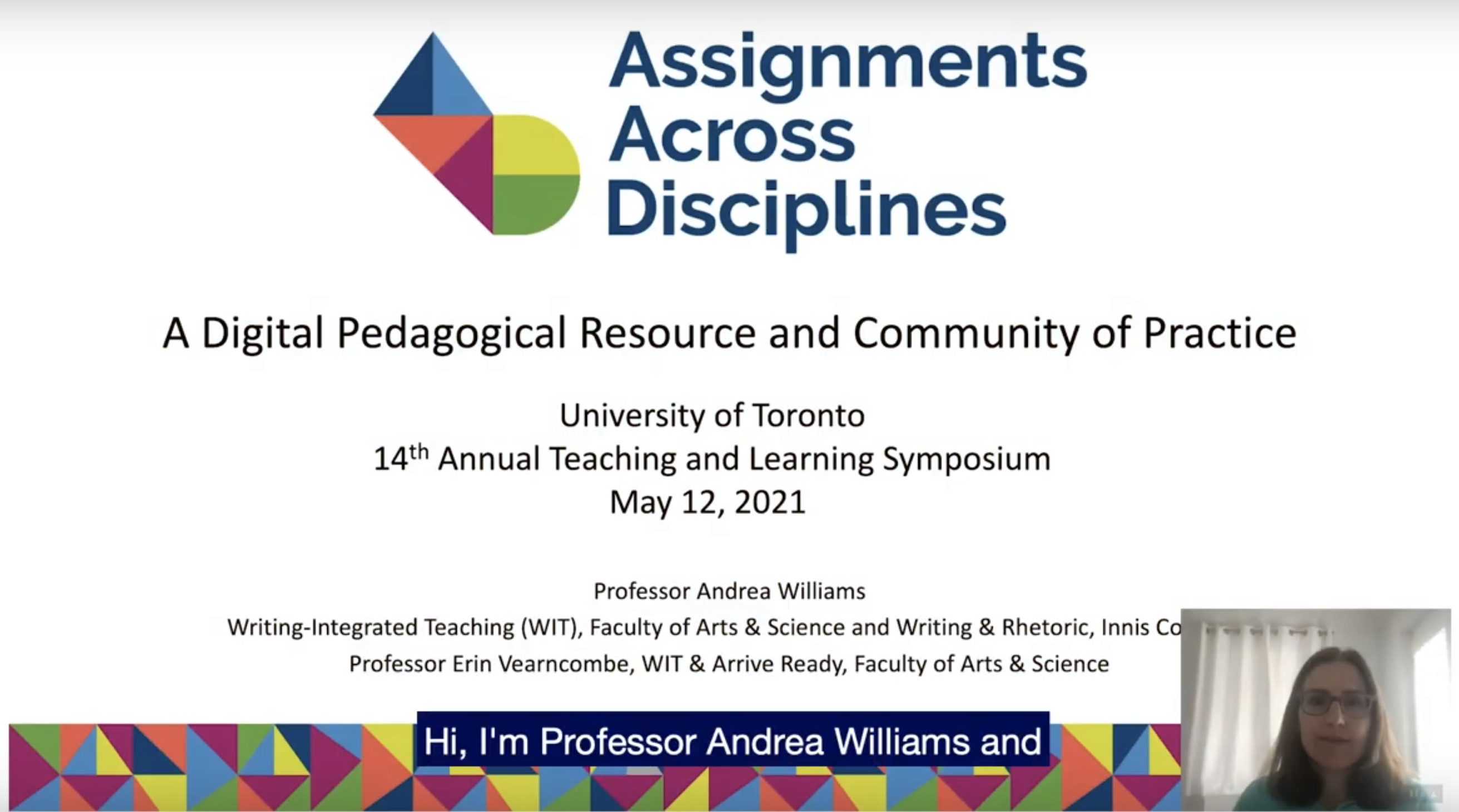
A part of 2.2: Lightning Talk session. Assignments Across Disciplines: Creating a Community of Practice around Assessment Andrea Williams, Associate Professor, Teaching Stream, FAS Erin Vearncombe, Assistant Professor, Teaching Stream, Dean’s Office, FAS Assignments play a vital role in both helping students acquire new knowledge and skills and documenting teaching excellence. This session explains how you can become involved in Assignments Across Disciplines (AAD), a university-wide LEAF-funded project that gives instructors a platform to share assignments and adapt colleagues’ assignments to fit their own teaching and learning goals and context. Combining an open-access database of exemplary and [...]

Assignments Across Disciplines: Creating a Community of Practice around Assessment2022-05-12T15:20:41-04:00

Promoting Wellness and Resiliency for Forensic Science Students

A part of 3.2: Lightning Talk session. Promoting Wellness and Resiliency for Forensic Science Students Karen Woodall, Assistant Professor, Teaching Stream, Anthropology/Forensic Science, UTM Andrea Carter, Assistant Dean, Student Wellness, Support & Success, UTM Students face many diverse stresses and mental health challenges during university and introducing a way to reflect and increase awareness of this topic can help students develop healthy coping skills and habits, increasing their wellness. This presentation showcases a “nifty assignment” that aims to educate undergraduate students about stress, wellness and resiliency. The assignment was introduced into a third-year course and involved students [...]

Promoting Wellness and Resiliency for Forensic Science Students2022-05-12T15:21:58-04:00

“A Picture is Worth a Thousand Words”: Preparing Future Nurses to Effectively Communicate Health-Information with Infographics

A part of 4.2: Lightning Talk session. “A Picture is Worth a Thousand Words”: Preparing Future Nurses to Effectively Communicate Health-Information with Infographics Zoraida Beekhoo, Associate Professor, Teaching Stream, Lawrence S. Bloomberg Faculty of Nursing Charlene Chu, RN, GNC(c), PhD, Assistant Professor, Lawrence S. Bloomberg Faculty of Nursing Lindsay Jibb, RN, PhD, CPHON, Assistant Professor, Lawrence S. Bloomberg Faculty of Nursing Neal MacInnes, Academic Information and Communication Technology Supervisor, Lawrence S. Bloomberg Faculty of Nursing Infographics serve as an effective way to present complex data in a visual format that is compelling, provides rapidly available information, and [...]

“A Picture is Worth a Thousand Words”: Preparing Future Nurses to Effectively Communicate Health-Information with Infographics2022-05-12T15:24:54-04:00
Go to Top